
A well-designed laundry room should make everyday chores easier, not create more clutter. Laundry room cabinets provide practical storage for detergent bottles, stain removers, towels, cleaning supplies, laundry baskets, and ironing accessories, helping keep everything organized and within easy reach.
The right laundry room cabinets can solve these problems by giving every item a dedicated place while making better use of vertical space. Smart storage solutions can also improve other areas of the home, including living room storage cabinet ideas for keeping everyday items organized. In addition, thoughtful cabinetry can improve both storage and appearance, whether you have a large utility room, a compact laundry room, or a laundry closet. As a result, a well-planned cabinet system can make everyday laundry tasks easier and help keep the room organized.
In this guide, you’ll discover 15 laundry room cabinet ideas, the best cabinet materials, storage features, layout tips, color options, organization strategies, and common mistakes to avoid.
Why Laundry Room Cabinets Matter
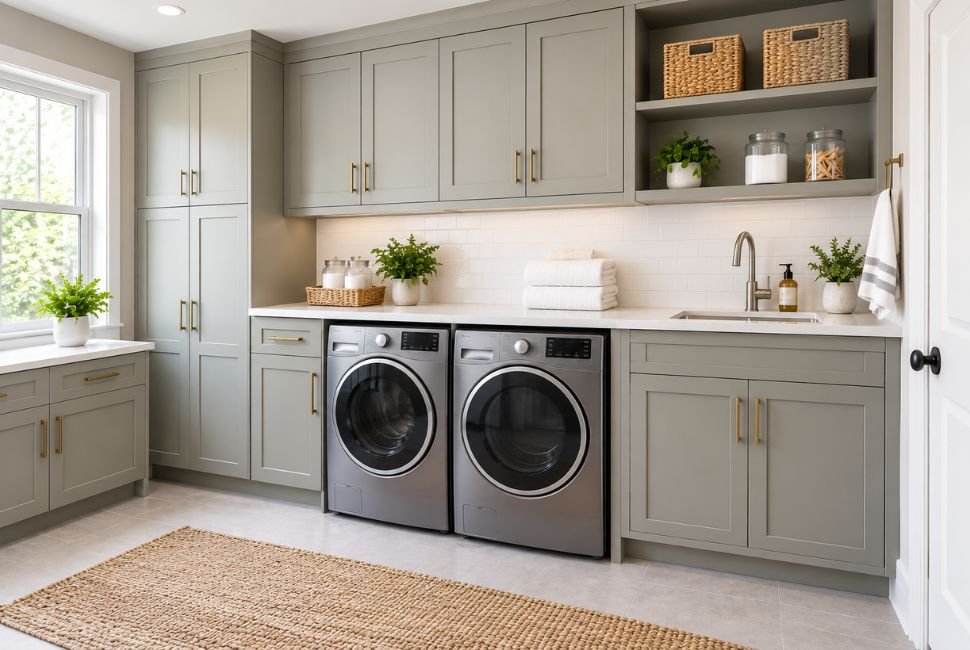
Laundry room cabinets do more than improve the appearance of a room. They provide organized storage for the products and equipment you use regularly.
Better Organization
However, Laundry supplies come in different shapes and sizes, making them difficult to organize on open shelves or countertops.
Cabinets can create dedicated storage zones for:
- Detergent and fabric softener
- Stain treatment products
- Towels and linens
- Cleaning supplies
- Laundry baskets
- Ironing accessories
- Seasonal household items
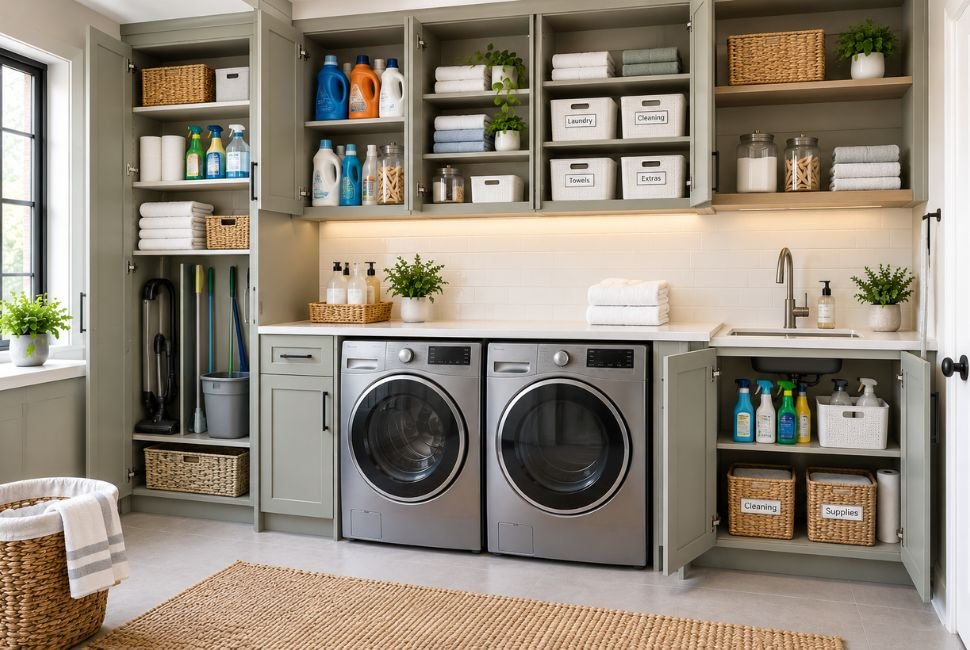
Keeping similar products together makes them easier to find and helps keep countertops clear.
A Cleaner, More Finished Appearance
Although Open shelving can be convenient, but bottles, boxes, and cleaning products remain visible. Closed cabinets hide everyday clutter and create a more streamlined appearance. Similar storage cabinet ideas for organizing your home can also help keep other living spaces neat.
For example, popular cabinet finishes include white, cream, gray, natural wood, sage green, and navy. The right choice depends on your room’s lighting and overall interior design.
Better Use of Vertical Space
The wall above a washer and dryer is often underused. For example Upper cabinets and tall storage units can turn that unused space into valuable storage without taking additional floor space.
For this reason, Floor-to-ceiling cabinets can be particularly useful for products and household equipment that you don’t need every day.
15 Laundry Room Cabinet Ideas
The best cabinet layout depends on your room size, appliances, storage requirements, and budget. Consider these ideas when planning your laundry room.
1. Floor-to-Ceiling Laundry Room Cabinets
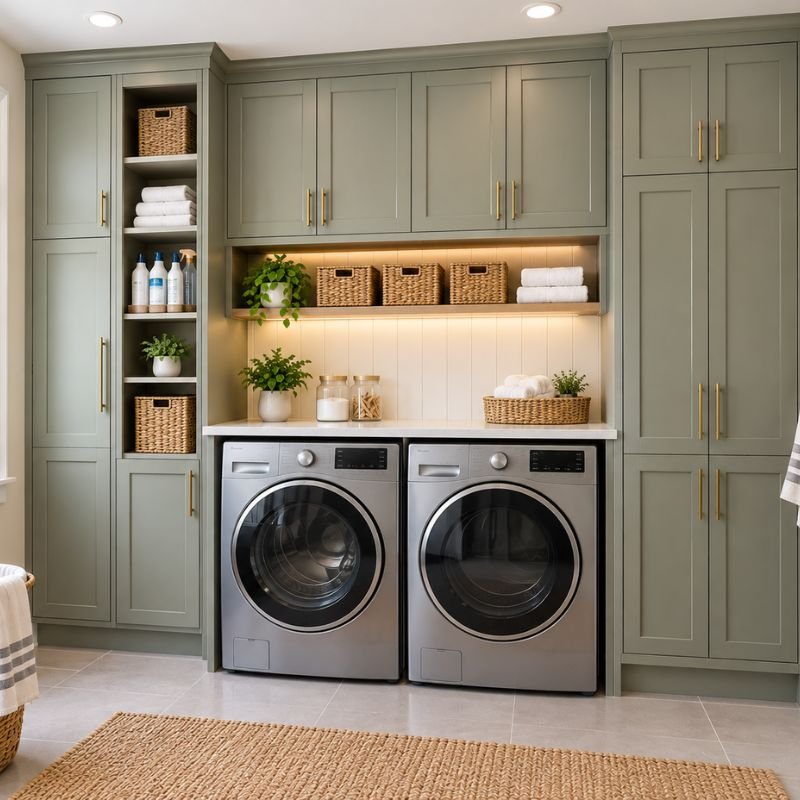
Tall cabinets make use of vertical space from floor to ceiling.
Use higher shelves for items you don’t need frequently, such as:
- Bulk cleaning supplies
- Extra towels
- Seasonal household products
- Cleaning equipment
- Other household storage
Keep everyday items at comfortable heights so they’re easy to access.
2. Cabinets Above the Washer and Dryer
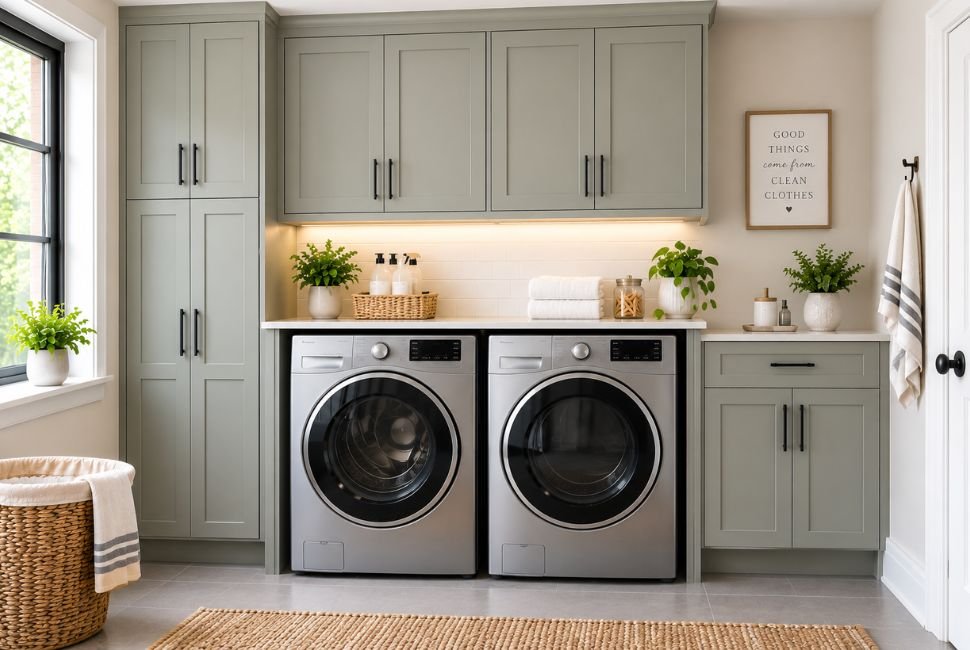
The wall above the appliances is one of the most useful locations for laundry storage.
Upper cabinets can store detergent, towels, cleaning products, and laundry accessories while keeping the floor clear.
Before installation, measure the appliances and check that cabinet doors can open without interfering with the machines.
3. Small Laundry Room Cabinets
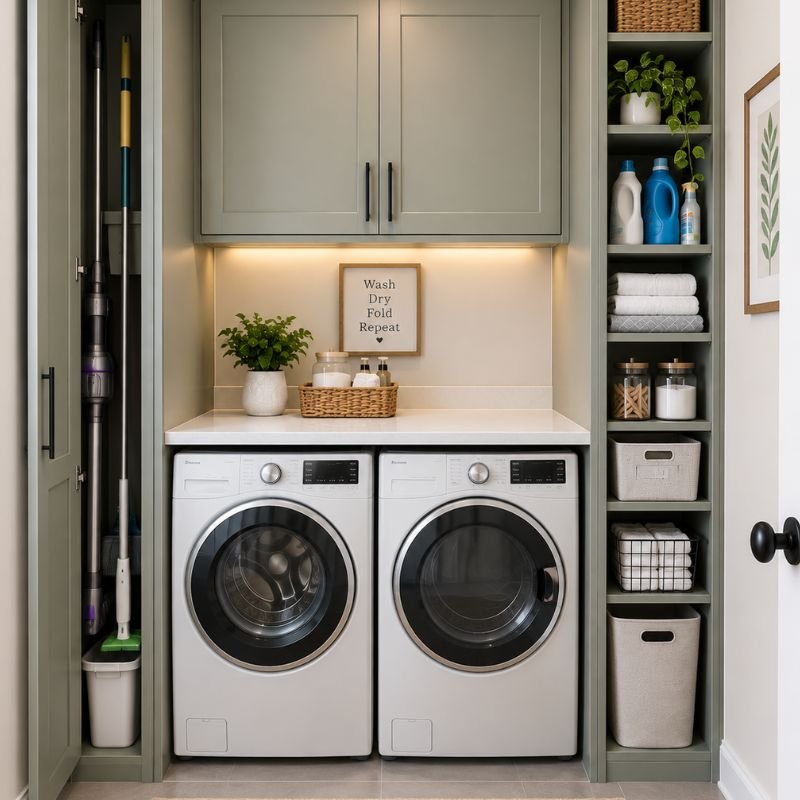
Fortunately, a small laundry room can still provide plenty of storage when the available wall space is used efficiently.
Consider:
- Tall narrow cabinets
- Upper cabinets
- Slim pull-out storage
- Wall-mounted storage
- Cabinets above appliances
- Adjustable shelves
Using vertical storage can increase capacity without making the room wider or more crowded.
4. Shaker Style Laundry Cabinets
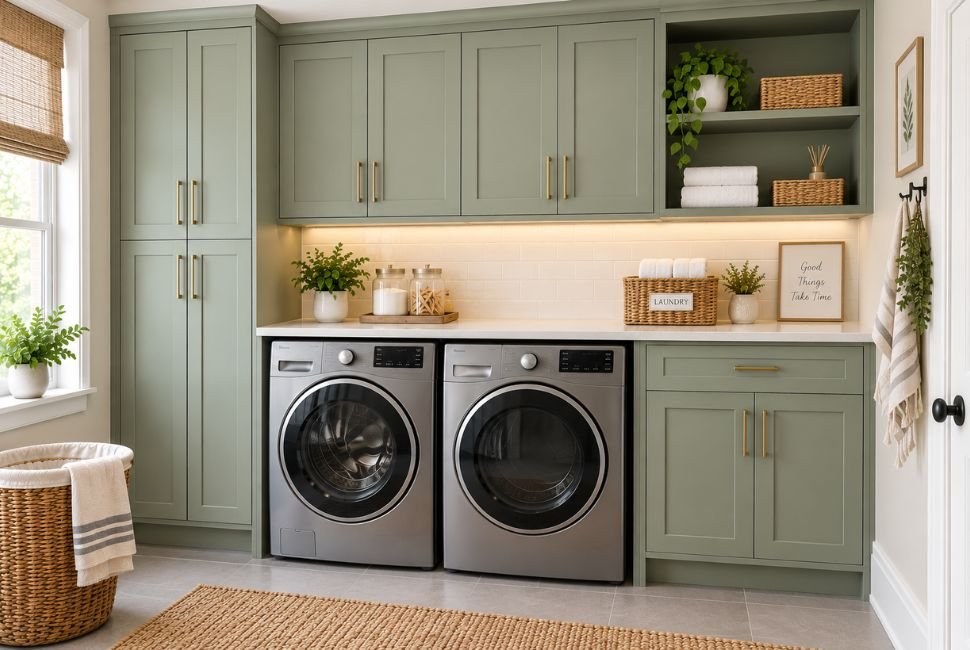
Moreover, shaker cabinets use a simple recessed-panel design that works with many interior styles.
They can create different looks depending on the finish:
- White for a bright, traditional appearance
- Cream for a soft and timeless look
- Dark gray for a modern appearance
- Muted green for a natural feel
- Navy for a stronger design statement
Their simple design also makes them easy to coordinate with countertops, walls, flooring, and cabinet hardware.
5. White Laundry Room Cabinets
White remains one of the easiest cabinet colors to coordinate with different laundry room styles. This versatile finish works particularly well with:
- White walls
- Wood accents
- Dark hardware
- Stainless steel appliances
- Light-colored countertops
The bright finish can also help a compact laundry room feel more open and inviting.
6. Gray Laundry Room Cabinets
Gray cabinets provide contrast while keeping the room neutral.
Soft gray works well with white appliances, light countertops, natural wood, and metal hardware.
Choose a warmer or cooler gray based on the existing colors and lighting in your laundry room.
7. Tall Utility Cabinets
A tall utility cabinet provides dedicated storage for long or bulky cleaning equipment.
It can hold:
- Brooms
- Mops
- Dusters
- Vacuum accessories
- Cleaning tools
- Folding laundry baskets
Keeping these items inside a full-height cabinet can prevent them from taking over the main work area.
8. Laundry Cabinets With a Countertop
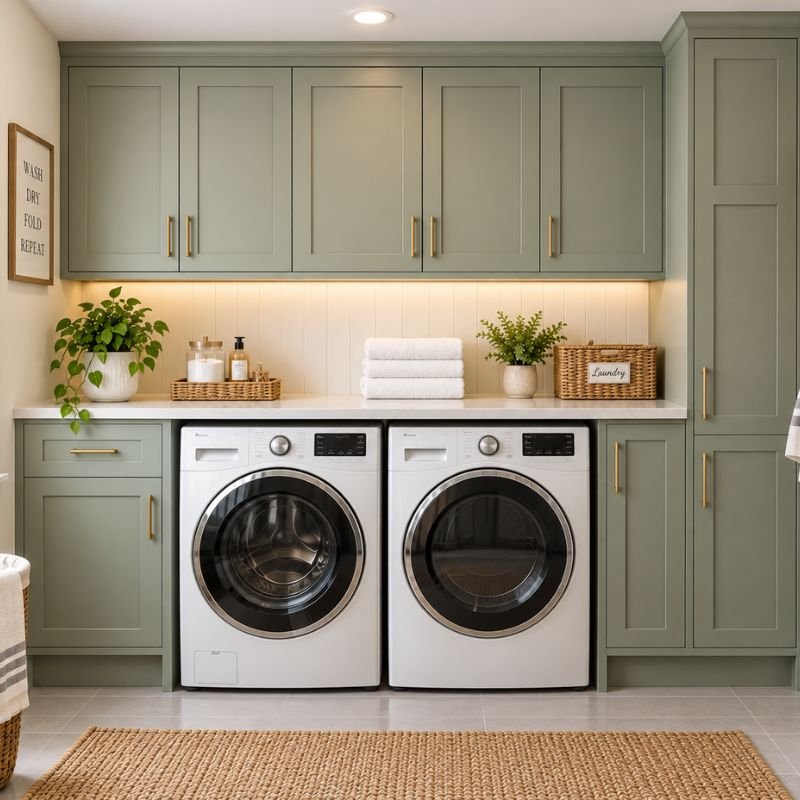
A countertop can turn the top of your cabinets or front-loading appliances into a useful work surface.
Use the surface for:
- Folding clothes
- Sorting laundry
- Organizing clean items
- Temporary storage
When choosing a countertop, consider moisture resistance, durability, ease of cleaning, and how well the surface works with your cabinet finish.
In particular, for front-loading machines, a continuous countertop can provide a particularly convenient folding area.
9. Built-In Drying Rack
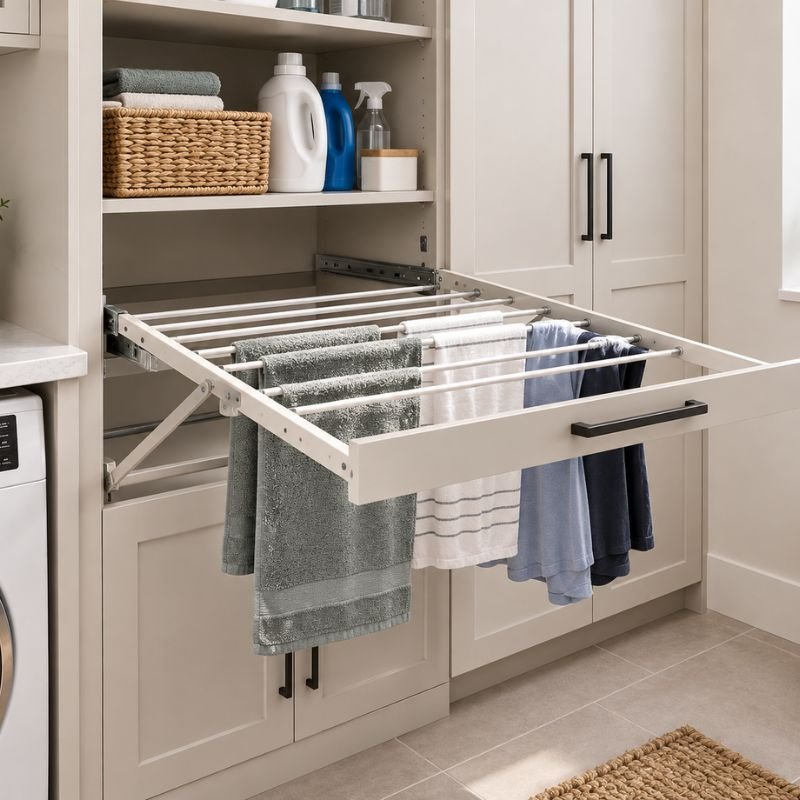
A pull-out or fold-down drying rack is useful if you regularly air-dry clothes.
Therefore the rack can remain hidden when it isn’t needed, saving valuable floor space.
This feature can be particularly useful in compact laundry rooms where every inch matters.
10. Pull-Out Hampers
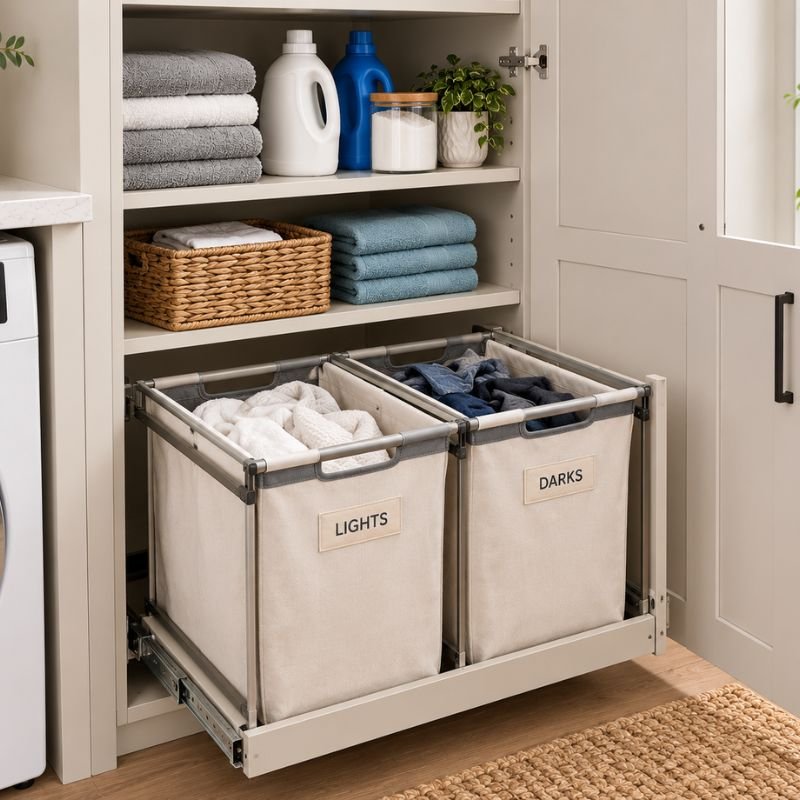
A built-in pull-out hamper keeps dirty laundry contained instead of leaving baskets on the floor.
Multiple compartments can also make sorting easier. For example, you can separate:
- Lights
- Darks
- Towels
When hampers are integrated into cabinetry, the laundry room can look cleaner and more organized.
11. Adjustable Shelving
Adjustable shelves are one of the most practical features for laundry room storage cabinets.
Because detergent containers, cleaning products, towels, and household supplies come in different sizes. Adjustable shelving lets you change the storage configuration as your needs change.
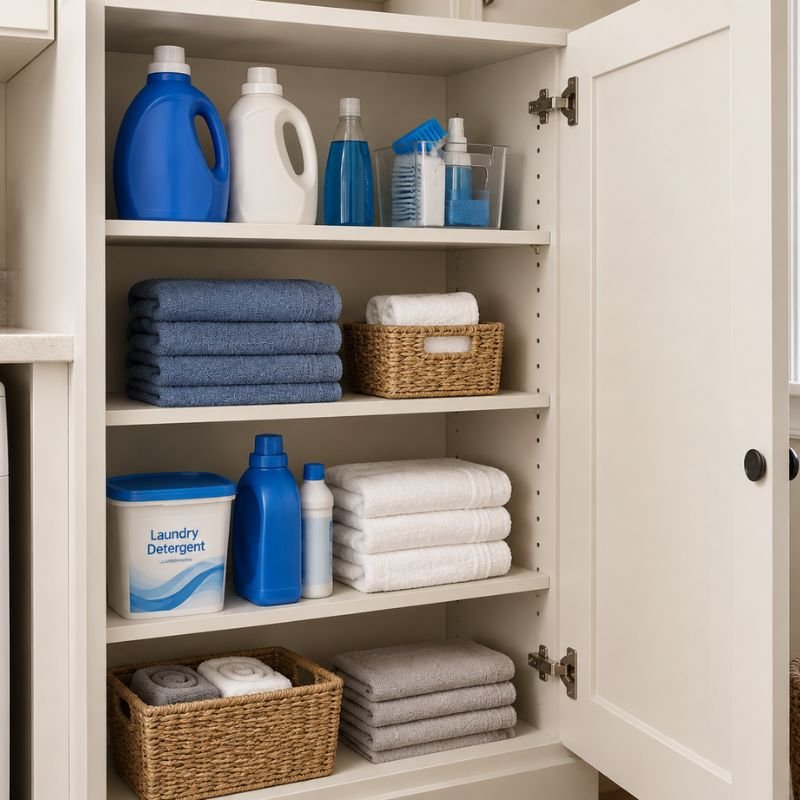
Use adjustable shelves for:
- Large detergent containers
- Small cleaning products
- Towels
- Laundry accessories
- Household supplies
12. Narrow Pull-Out Storage
Even a narrow gap between cabinets or appliances may provide an opportunity for additional storage.
A slim pull-out cabinet can hold:
- Stain removers
- Brushes
- Cleaning cloths
- Sponges
- Small bottles
This type of storage is especially useful in narrow laundry room layouts.
13. Integrated Ironing Board Cabinet
An integrated ironing board keeps a bulky ironing board out of sight when it isn’t being used.
Instead of leaning an ironing board against a wall, you can store it inside a cabinet designed for that purpose.
This can free up valuable floor space and keep the room looking more organized.
14. Cabinet Door Organizers
The inside of cabinet doors provides additional storage that is often overlooked.
Door-mounted organizers can hold small items such as:
- Lint rollers
- Stain pens
- Dryer sheets
- Small cleaning tools
- Laundry accessories
This makes frequently used items easier to find without taking up valuable shelf space.
15. Laundry Cabinets With a Utility Sink
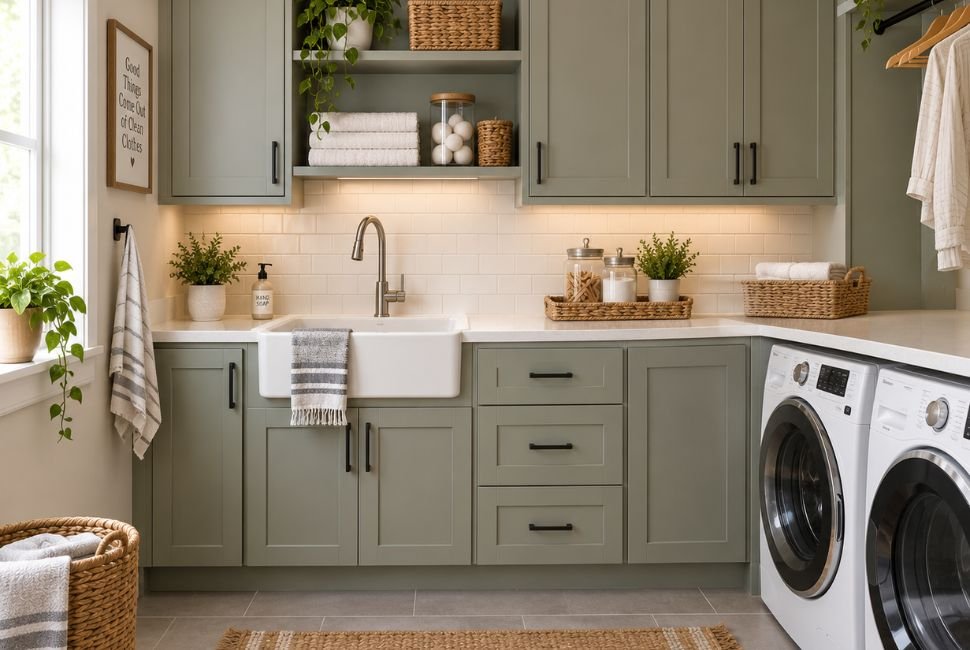
A utility sink can make a laundry room more versatile.
It can provide a convenient place for:
- Hand-washing clothes
- Soaking items
- Cleaning household tools
- Handling messy tasks
Pairing a utility sink with a base cabinet and countertop can create a practical laundry workstation.
Best Materials for Laundry Room Cabinets
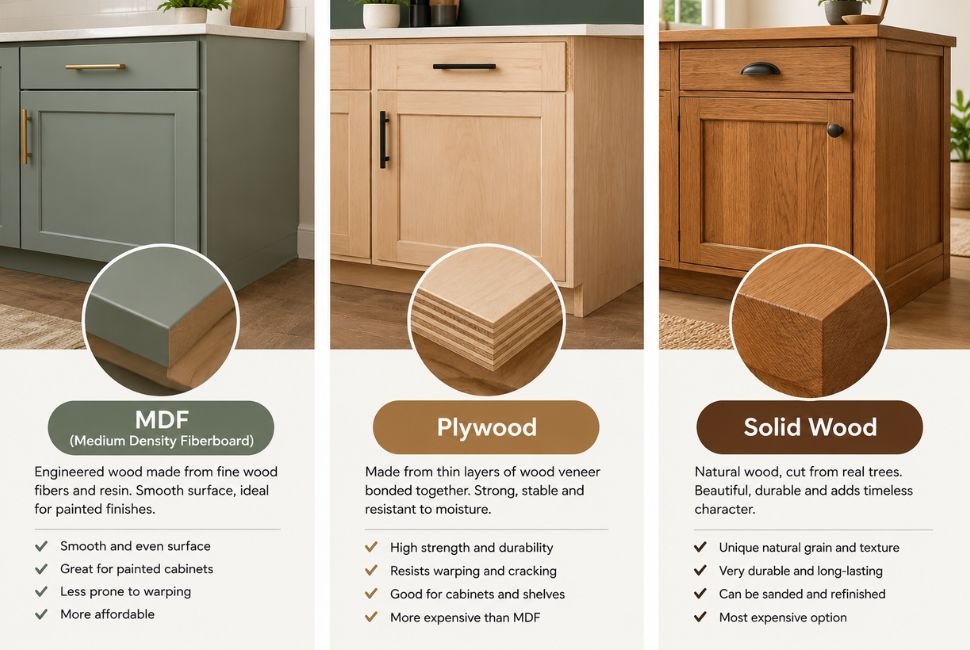
When choosing materials, laundry rooms can experience humidity, splashes, temperature changes, and accidental leaks. Material selection is therefore an important part of cabinet planning. Similar considerations apply to compact cabinetry in other areas of the home, especially when choosing a 24-inch bathroom vanity for a small space.
Three common options are MDF, plywood, and solid wood.
MDF Cabinets
However, medium-density fiberboard, or MDF, provides a smooth surface that works particularly well with painted cabinet doors.
Advantages
- Smooth, consistent finish
- Excellent for painted doors
- Often more affordable than solid wood
- Works well with modern cabinet designs
Standard MDF can be affected by moisture, so moisture-resistant MDF and properly sealed edges are preferable for a laundry environment.
Plywood Cabinets
In comparison, plywood is made from multiple layers of wood veneer and is commonly used for cabinet boxes and structural components.
Advantages
- Strong construction
- Good screw-holding ability
- Suitable for drawers and cabinet boxes
- Good performance when properly finished and protected
For many projects, plywood provides a practical balance between durability and cost.
Solid Wood Cabinets
Solid wood provides a natural appearance and can create a premium look.
Common choices include:
- Oak
- Maple
- Hickory
Solid wood can be an excellent choice for custom cabinetry, but it generally costs more than MDF or plywood.
Regardless of the material, construction quality, finishing, and moisture protection remain important.
How to Plan a Laundry Room Cabinet Layout
Before ordering or building cabinets, measure the entire room rather than estimating from photographs.
Record:
- Wall width
- Ceiling height
- Washer dimensions
- Dryer dimensions
- Door swings
- Window locations
- Plumbing locations
- Electrical outlets
- Dryer vent location
- Available walking space
In addition, check how appliance doors open.
However, a cabinet arrangement may look good on paper but become inconvenient if it prevents you from opening the washer or dryer comfortably.
Keep Everyday Items Easy to Reach
Frequently used products such as detergent, stain removers, and laundry accessories should be stored where they are easy to reach.
Less frequently used products can go into higher cabinets.
Store Heavy Items Lower
Large detergent containers and other heavy products are generally easier to handle when stored on lower shelves or inside base cabinets.
Avoid placing unnecessarily heavy items in difficult-to-reach upper cabinets.
Use Vertical Storage
Tall cabinets are particularly valuable in small laundry rooms because they increase storage capacity without requiring additional floor space.
Laundry Room Cabinet Dimensions and Clearance
There is no single cabinet dimension or installation height that works for every laundry room.
The appropriate configuration depends on:
- Washer and dryer size
- Appliance type
- Cabinet design
- Countertop configuration
- Ceiling height
- Available wall space
- Door swings
- Plumbing
- Electrical connections
- Ventilation and service access
Therefore, for cabinets installed above a washer and dryer, always check the actual appliance dimensions and installation requirements before finalizing the cabinet design.
The cabinet doors should open comfortably, and the cabinetry should not interfere with appliance operation, ventilation, plumbing, or maintenance.
Important: Measure your actual appliances rather than relying only on generic cabinet dimensions.
Best Cabinet Colors for a Laundry Room
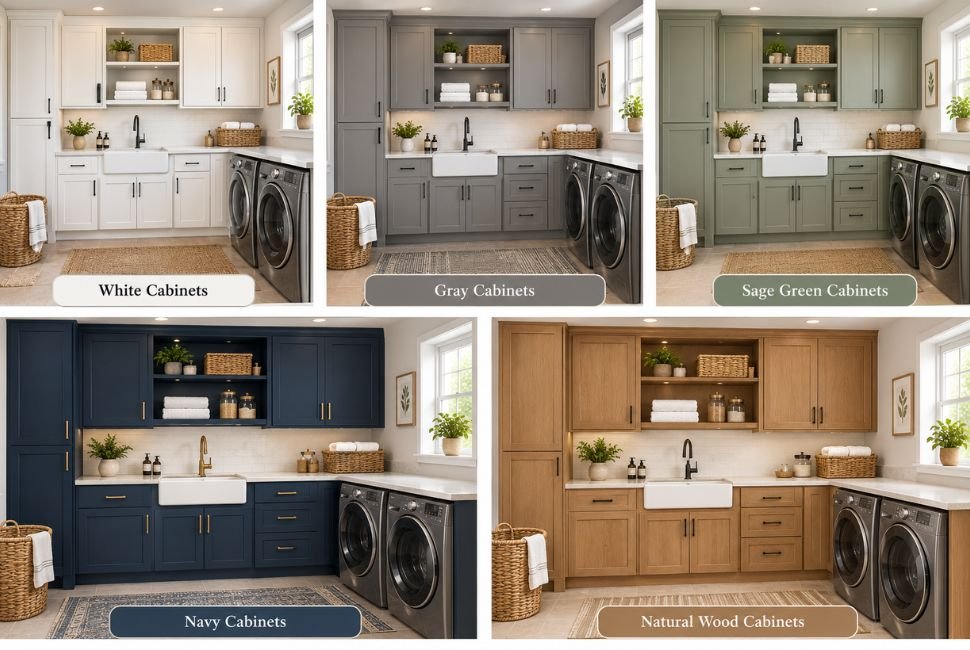
Cabinet color can influence how bright, spacious, or dramatic the room feels. When choosing colors for connected spaces, it can also help to coordinate cabinet finishes with surrounding walls and kitchen wall decor ideas.
White
White cabinets create a clean, bright appearance and coordinate easily with most appliances and finishes.
Soft Gray
Similarly, soft gray provides subtle contrast while keeping the room neutral.
Sage Green
Muted sage green introduces color while maintaining a calm, natural appearance.
Navy
Navy creates a stronger visual statement and works particularly well with light countertops and contrasting hardware.
Natural Wood
Finally, natural wood finishes add warmth and texture to a utility space and can complement other natural materials.
For a small laundry room, coordinating the cabinet and wall colors can create a more connected appearance.
Choosing Laundry Room Cabinet Hardware
Cabinet hardware affects both appearance and everyday usability.
Common choices include:
- Knobs
- Bar pulls
- Cup pulls
- Recessed handles
- Push-to-open hardware
In particular, in narrow laundry rooms, low-profile hardware can reduce protruding objects around walkways.
Popular finishes include matte black, brass, chrome, and brushed metal. Choose hardware that works with the room’s existing fixtures for a more consistent design.
Laundry Room Cabinets With a Countertop
A countertop can become one of the most useful parts of a laundry room.
It provides a dedicated surface for folding clothes, sorting laundry, and organizing clean items.
When selecting a countertop, consider:
- Moisture resistance
- Ease of cleaning
- Durability
- Cabinet compatibility
- Available workspace
For front-loading appliances, a countertop across the machines can create a continuous folding surface.
Try to keep the countertop relatively clear so the laundry room remains easy to use.
How to Organize Laundry Room Cabinets
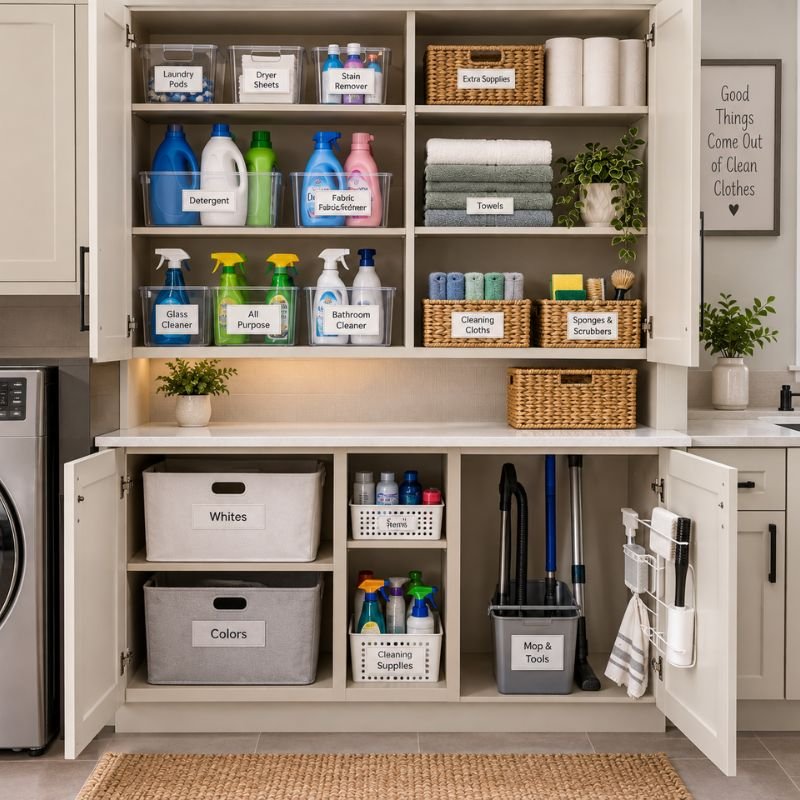
Most importantly, the exterior of your cabinets affects the appearance of the room, but the interior organization determines how useful the storage becomes.
Create Dedicated Storage Zones
Assign a purpose to each cabinet.
For example:
Cabinet 1: Detergent and fabric softener
Cabinet 2: Towels and linens
Cabinet 3: Cleaning products
Cabinet 4: Ironing supplies
Cabinet 5: Household extras
This simple system prevents different categories from becoming mixed together. The same principle works in other storage areas too. For example, these bathroom cabinet organization ideas can help you create dedicated zones, use vertical space, and keep smaller products easy to find.
Use Storage Bins
In addition bins are useful for grouping small accessories.
Use them for:
- Cleaning cloths
- Sponges
- Brushes
- Laundry accessories
- Small household items
Labeling bins can make supplies easier to find.
Use Lower Storage for Large Containers
Store large detergent bottles and other bulky products where they are easier to lift.
This also reduces the need to reach into high cabinets while handling heavy containers.
Make Use of Cabinet Doors
Door organizers can store small, frequently used products that might otherwise disappear at the back of a shelf.
Stock vs. Semi-Custom vs. Custom Laundry Cabinets
Your budget and room layout should determine which type of cabinetry makes the most sense.
Stock Cabinets
Stock cabinets come in standard sizes and can be practical for straightforward layouts.
They may work well when:
- The room has a simple shape
- Standard sizes fit the available space
- You have a tighter budget
- You want a simpler installation
Semi-Custom Cabinets
Semi-custom cabinetry usually provides more flexibility in sizes, finishes, and storage features.
It can be a useful middle ground between standard stock cabinets and fully custom cabinetry.
Custom Cabinets
Custom cabinets are designed specifically for your room.
They can be particularly useful for:
- Awkward corners
- Unusual dimensions
- Limited wall space
- Special storage requirements
- Built-in appliance configurations
The best choice is the one that fits both your space and the way you actually use your laundry room.
Laundry Room Cabinets on a Budget
A complete custom renovation isn’t always necessary.
Start by identifying the storage problems that affect your daily routine the most.
You might prioritize:
- Cabinets above the appliances
- A tall utility cabinet
- Adjustable shelves
- Pull-out hampers
- A countertop
- Specialty storage features
Advanced features can be added later as your budget allows.
Simple cabinet doors, standard hardware, and an efficient layout can also help control project costs.
Note: Exact cabinet costs vary significantly by location, materials, cabinet size, installation, and customization, so a reliable estimate should be based on your specific project rather than a generic figure.
Common Laundry Room Cabinet Mistakes to Avoid
1. Ignoring Appliance Measurements
Always measure the washer and dryer before ordering or building cabinets.
2. Blocking Ventilation or Access
Cabinetry should not interfere with appliance ventilation, plumbing access, electrical components, or routine maintenance.
3. Wasting Vertical Space
Leaving large unused areas above cabinets can reduce your potential storage capacity.
4. Choosing Appearance Over Function
A beautiful cabinet layout isn’t useful if everyday supplies are difficult to reach.
5. Using Too Much Open Storage
Open shelving can quickly become visually cluttered when covered with bottles, boxes, and cleaning products.
6. Forgetting Interior Organization
Cabinets work best when the inside is planned as carefully as the doors and exterior finish.
How to Maintain Laundry Room Cabinets
Proper maintenance can help keep your cabinets looking clean and functioning correctly.
Wipe up detergent spills promptly and avoid leaving standing moisture on cabinet surfaces.
Use cleaning products appropriate for the cabinet finish and avoid excessive water around seams and edges.
Periodically check for:
- Loose hinges
- Damaged finishes
- Swollen areas
- Loose drawer slides
- Water leaks
- Worn seals
Addressing small problems early can help prevent more difficult repairs.
Smart Laundry Cabinet Features Worth Adding
Modern laundry room cabinets can include more than basic shelves and doors.
Depending on your space and budget, consider:
- Soft-close hinges
- Soft-close drawer slides
- Pull-out hampers
- Adjustable shelves
- Built-in drying racks
- Door-mounted organizers
- Appliance bridging cabinets
- Tall utility storage
- Integrated ironing boards
- Interior lighting
You don’t need every feature. Choose the options that solve actual storage or workflow problems in your laundry room.
Final Thoughts
The best laundry room cabinets combine storage, durability, accessibility, and style.
Start by measuring your room and appliances, then identify the items you need to store most often. Use vertical space efficiently, choose materials that suit the laundry environment, and organize cabinets around the way you actually use the room.
For small laundry rooms, tall cabinets, upper storage, narrow pull-outs, and adjustable shelves can make a significant difference. Larger rooms can accommodate combinations of base cabinets, countertops, utility storage, sinks, and specialty features.
The goal isn’t simply to install more cabinets. It’s to create a practical storage system that reduces clutter, keeps supplies organized, and makes the entire laundry routine easier.
FAQs About Laundry Room Cabinets
1. What is the best material for laundry room cabinets?
Plywood, moisture-resistant MDF, and properly finished solid wood can all work well depending on your budget, design preferences, and construction method. In a laundry environment, sealed edges and moisture protection are especially important.
2. Can I install laundry room cabinets in a small space?
Yes. Small laundry rooms can benefit from vertical cabinets, upper storage, narrow pull-outs, and cabinets above the appliances.
3. Can cabinets go above a washer and dryer?
Yes. Cabinets can be installed above the appliances when the layout provides appropriate clearance and doesn’t interfere with appliance operation, ventilation, plumbing, or maintenance.
4. What are the best colors for laundry room cabinets?
White, soft gray, sage green, navy, and natural wood are versatile choices. The best option depends on your room’s lighting, wall color, flooring, appliances, and overall interior style.
5. Are adjustable shelves worth adding?
Yes. Adjustable shelves make it easier to store products of different sizes and change the cabinet layout as household needs change.
6. Should I choose stock or custom laundry cabinets?
Stock cabinets can work well for simple layouts and tighter budgets. Semi-custom and custom cabinets offer more flexibility when the room has unusual dimensions or specific storage requirements.
7. What should I store in laundry room cabinets?
Common items include detergent, fabric softener, stain removers, towels, cleaning products, ironing supplies, laundry accessories, and household tools.
8. How can I make a small laundry room feel less crowded?
Use vertical storage, keep countertops clear, choose low-profile hardware, organize products into storage zones, and consider coordinating cabinet and wall colors.
9. Are laundry cabinets with countertops useful?
Yes. A countertop provides a convenient surface for folding clothes, sorting laundry, and organizing clean items.
10. How can I protect laundry room cabinets from moisture?
Choose suitable materials and finishes, wipe up spills quickly, maintain appropriate ventilation, and repair plumbing leaks promptly.
11. What are the best cabinet features for laundry organization?
Adjustable shelves, pull-out hampers, tall utility storage, drying racks, door organizers, and integrated ironing boards can all improve organization.
12. Do laundry room cabinets need ventilation?
The cabinet layout should not block required appliance ventilation or airflow. Follow the installation requirements for your specific appliances and maintain access for servicing.
13. Can I use kitchen cabinets in a laundry room?
Kitchen-style cabinetry can often work in a laundry space if the material, finish, dimensions, and installation are suitable for the environment and appliance layout.
14. How deep should laundry room cabinets be?
Cabinet depth depends on whether the cabinet is installed above appliances, used as a base cabinet, or designed as tall utility storage. Measure your available space and appliance clearances before selecting standard or custom dimensions.
15. What is the most important laundry cabinet planning tip?
Measure the room and appliances first. A detailed layout can help prevent clearance problems and make better use of the available storage space.